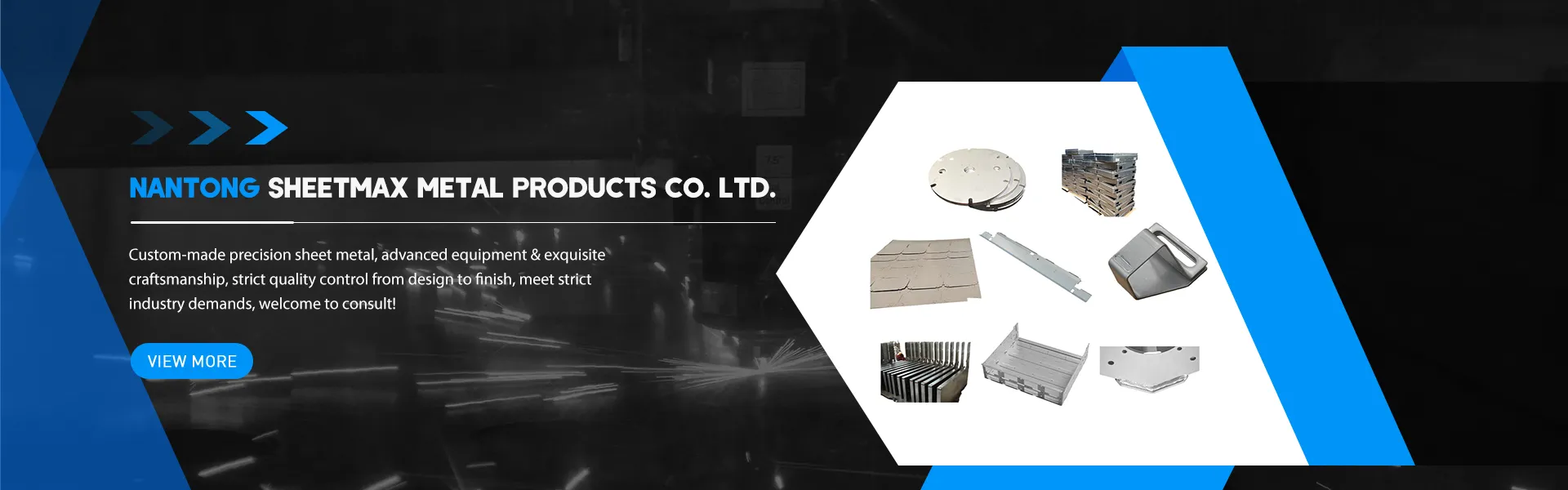
Laser Cutting Service

SheetMax:Your Professional Laser Cutting Service manufacturer!


SheetMax has been in the precision sheet metal manufacturing industry for 7 years, sheetmax has grown to over 25 employees, and locations of operations consisting of a total of 25,000 sq. ft.Our skilled engineering team is equipped to handle all aspects of the sheet metal forming and sheet metal bending process, including design, laser cutting, bending, stamping, welding, assembly and powder coating. We don't just do metal forming, we offer all-in-one services that provide a completed product that goes above and beyond your expectations.


Why Choose Us

Professional team

Our team of passionate engineers is here to offer guidance on product design, powder coating, welding, and many other aspects of the sheet metal forming process. From concept to completed product, we will ensure that your needs are met every step of the way so that the final product is one that you're proud of and happy with.


Advanced production equipment

We have advanced production equipment, including 3 laser cutting machines, 1 CNC punching machine, 4 CNC bending machines, 2 punching machines, 2 riveting machines, 5 drilling machines, 10 welding machines, 3 plate rolling machines and 2 cutting machines.

Fast delivery

We have full stock, and can deliver within short time. Many styles for your choices.

Quality assurance

We have 100% quality guarantee to customers. We will be responsible for any quality problem.

Good service

High-quality after-sales service, tracking usage, and positive feedback. Rapid response within 24 hours.


Advantages of Laser Cutting Service
productcate-600-600

High Precision

Laser cutting ensures high precision and accuracy, enabling intricate designs and tight tolerances, minimising material waste.


Versatility

Laser cutting can be used with a wide range of materials, including steel, aluminum, stainless steel, and more. It can handle various thicknesses and sheet sizes, making it versatile for different applications.


Speed

Laser cutting is faster than traditional methods, swiftly cutting through materials, enhancing productivity, and reducing lead times.


Clean Cuts

Laser cutting produces clean, burr-free edges, reducing the need for secondary finishing processes.


Automation

Easily integrated into our automated processes, laser cutting enhances efficiency, reducing costs and improving production.

Non-contact

Laser beams don’t touch material, minimising wear, maintenance, and prolonging machinery lifespan.


Used for Jobs of Vast Complexity

Laser cutting enables the creation of complex geometries and intricate patterns, ideal for challenging designs and precise cuts.


Customisation

Laser cutting facilitates easy customisation and prototyping, suitable for small-batch production or unique designs.


Eco-Friendly

With minimal waste generation, low energy consumption, and fewer emissions, fibre laser cutting is relatively eco-friendly.


Cost-Effective

Long-term savings from efficiency, waste reduction, and lower labour costs make laser cutting economically viable.

productcate-600-600


Specification


Product name

Laser Cutting Service

Material

Aluminum, Steel, Stainless Steel, Brass, Copper, Iron etc.

Size

Custom according to drawing or sample

Tolerance

+/-0.002~+/-0.005mm

Drawing Format

3D/CAD/STP/IGS/PDF/CDR Format

Surface Finish

Polishing, Passivating, Sandblasting, Brushing, Laser Engraving, Anodizing, Electroplating, Painting, Powder Coating etc.

Certification

ISO9001

Color

Customized

Logo

Accept (Laser engraving, CNC Engraving, Screen-printing etc.)


Application of Laser Cutting Service

Automotive industry

When it comes to manufacturing vehicle parts, the automotive industry requires high precision and tighter tolerances. This is where laser cutting comes into play as it effectively fulfills the standards of the automotive industry with its adaptability and ability to fabricate intricate shapes and designs.


Construction industry

The construction industry relies on laser cutting to manufacture its structural components. As most tools and equipment in the construction industry are usually large and complex, precise and accurate fine cutting of building components is required. Laser cutting is responsible for the fabrication of large-scale projects for residential and commercial properties. These include bridges, tunnels, connecting plates, base plates, and other materials.


Electronics industry

In the electronics industry, laser machines are widely used to cut delicate electronic components with precision. Tube laser cutting is used to cut components such as circuit boards, enclosures, connectors, and heat sinks. The accuracy of tube laser cutting guarantees precise measurements and intricate designs in small components.


Medical equipment industry

Medical devices and equipment such as X-ray and FMRI consist of complex components that require the use of various manufacturing technologies. Laser cutting finds application in fabricating several components for such machines, including their sheet metal housings. Furthermore, fiber lasers are also used in cutting a variety of materials involving bone, tissue, and plastic as well as in the manufacture of surgical instruments and other medical devices.


Military industry

Laser cutting parts play a vital role across all military industries, whether on land, in the air, or at sea. Apart from this, laser marking and laser engraving techniques are also used across the defence sector to add text and graphics to a wide range of military gears and equipment including knives, flashlights, firearms, military vehicles, helicopter parts, and other tactical gears.


Aerospace industry

The aerospace industry is one of the most demanding in terms of precision and quality assurance. Known for its extensive utilisation of precision engineering, the aerospace sector heavily relies on laser cutting metal for the construction of mechanical devices, airplane parts, and spacecraft components.


Metalworking industry

Metalworking refers to the process of shaping, manipulating, and cutting sheet metal into various shapes, components, or products. Using the different techniques and methods of laser cutting, the metalworking industry is able to achieve precision and accuracy in cutting even the most complex parts.


Material of Laser Cutting Service


Carbon Steel

There are different categories of carbon steel. They have varying amounts of carbon content ranging from 0.12% to 2%. The higher the carbon content, the lower the melting point and the easier it is to laser cut.

Stainless Steel

Known for its corrosion resistance and strength, stainless steel is widely used in construction, automotive, and medical applications. Laser cutting provides precise and clean cuts, essential for intricate designs.

Titanium

Titanium is strong with a high melting point. Though challenging, it is possible to cut with the right settings. Laser-cut titanium has a widespread application because of its exceptional strength and lightweight nature.

Copper

Copper has a good thermal and electrical conductivity making it a suitable candidate for laser cutting. Fiber laser is the ideal type as it reduces copper discoloration issues.

Aluminum

Laser cutting aluminum is a popular process in manufacturing industries. This is because aluminum is highly reflective making it easy to cut more quickly. Virtually any laser can be used.

Brass

Brass is an alloy of zinc and copper. Copper is soft making brass easier to cut using lasers. CO2 and fibers are the most common for laser brass cutting.

Plastics

Plastics are another category of materials one can laser cut. The most suitable is CO2 lasers as most plastics absorb energy at that wavelength. Fiber lasers also work.

Wood

Lasers can mark, cut, and engrave wood seamlessly. CO2, fiber, and diode lasers work perfectly with both hard and soft woods.

Glass

Precision and non-contact nature of laser cutting make it suitable for delicate glass cutting, particularly in architectural and automotive applications.


Fine Laser Cutting Services


Three methods for laser cutting sheet metal

1. Laser beam fusion cutting

The laser beam fusion cutting process uses an inert gas, mostly nitrogen. The low-reaction process gas continuously vaporizes the cutting gap of the material. As the molten material gets removed, inert gas prevents oxidation at the cutting edge without interfering with the process.

This laser cutting method is suitable for cutting flat, thin sheets of aluminum alloys and stainless steel that require high aesthetic appeal and fewer finishing operations.


2. Laser beam sublimation cutting

As the name suggests, laser beam sublimation cutting evaporates the material. Instead of melting the material like other laser cutting processes, they are immediately changed from solid to gas – sublimation.

Like fusion cutting, laser beam sublimation cutting uses inert gases to blow the material’s vapor out of the kerf. So, there are no oxidants on the cutting edge. It is often used in cutting organic materials like wood, leather, textiles, etc.


3. Laser beam flame cutting

Laser beam flame cutting uses a combustible gas – oxygen to thrust out the molten material. The laser heats the workpiece creating spontaneous combustion after melting the material. The oxygen gas provides more energy for the cutting process through oxidation – an exothermic reaction.

Flame cutting is ideal for cutting mild steel and fusible materials such as ceramics. This cutting process May cause burns on the cutting surface since the gas is an oxidant. Proper optimization of the process parameters will help prevent the formation of burrs.


Packaging and Shipping


productcate-1-1


FAQ

Q: How can I get a quote?

A: If you are a professional, you can get a quote by sending drawings and requirements or instructions. We will reply to you as soon as possible and provide you with a quote.
If you are not a professional, you can tell us your specific needs. Our professional team will provide you with multiple customized solutions based on your needs and provide you with a quote.

Q: What is the delivery time?

A: The delivery time will depend on the order quantity. We usually complete the delivery within 3-15 days after order confirmation.

Q: Can I get a sample to check?

A: Yes, you can. You only need to pay the cost of the sample, and we will refund it to you during mass production.

Q: How can I customize a part if I can't draw?

A: No problem. Tell us your requirements and we provide design services.

Q: What should I do if I encounter any problems after receiving the product?

A: You can provide feedback to our after-sales service team through voice calls, video conferences, emails, and other methods. Our team will reply to you within 24 hours and provide you with the best solution within a week.

Q: What Can Laser Cutting Do?

A: Laser cutting helps produce some fantastic products, and it is used in many industries such as the automotive and aerospace industries. It helps achieve results according to the designs made before operating the machine. The laser cutter can cut through almost all materials, including metals, chrome, aluminum, and plastics.

Q: Why is Laser Cutting Perfect for Mass Production?

A: One of the advantages of using laser cutting is the high precision and accuracy of the machine in producing and replicating results. As a manufacturing industry, when making a product, you will want to ensure it is of the highest quality. This is what laser cutting offers, producing the same product with precision and accuracy in high volume. Other advantages such as the time saving and reducing the cost of production are other things that make laser cutting perfect for mass production.

Q: How Does Laser Cutting Work?

A: Laser cutting works by directing a high-powered beam of light into a sheet of material to produce a 2-dimensional profile. In the case of common lasers like CO2 and fiber lasers, the beam is generated inside a resonator that amplifies the light energy until it reaches the desired energy level. The beam is then directed using mirrors (in CO2 lasers) or fiber optic cables (in fiber lasers) onto the material surface. The laser melts, burns, or removes the material to create the cut-through.

Q: What are the forms of laser cutting?

A: The common forms of laser cutting are fusion cutting, flame cutting, remote cutting, thermal stress fracture, stealth dicing, and laser rastering.

Q: What plastic can you not laser cut?

A: Polycarbonate is a poor choice for laser cutting. ABS Emits cyanide gas and tends to melt ABS does not cut well in a laser cutter.

We're professional laser cutting service manufacturers and suppliers in China, specialized in providing high quality customized service. If you're going to buy laser cutting service, welcome to get quotation from our factory.

laser cutting service, Fine Laser Cutting Services, Irregular Shapes Laser Cutting

(0/10)

clearall